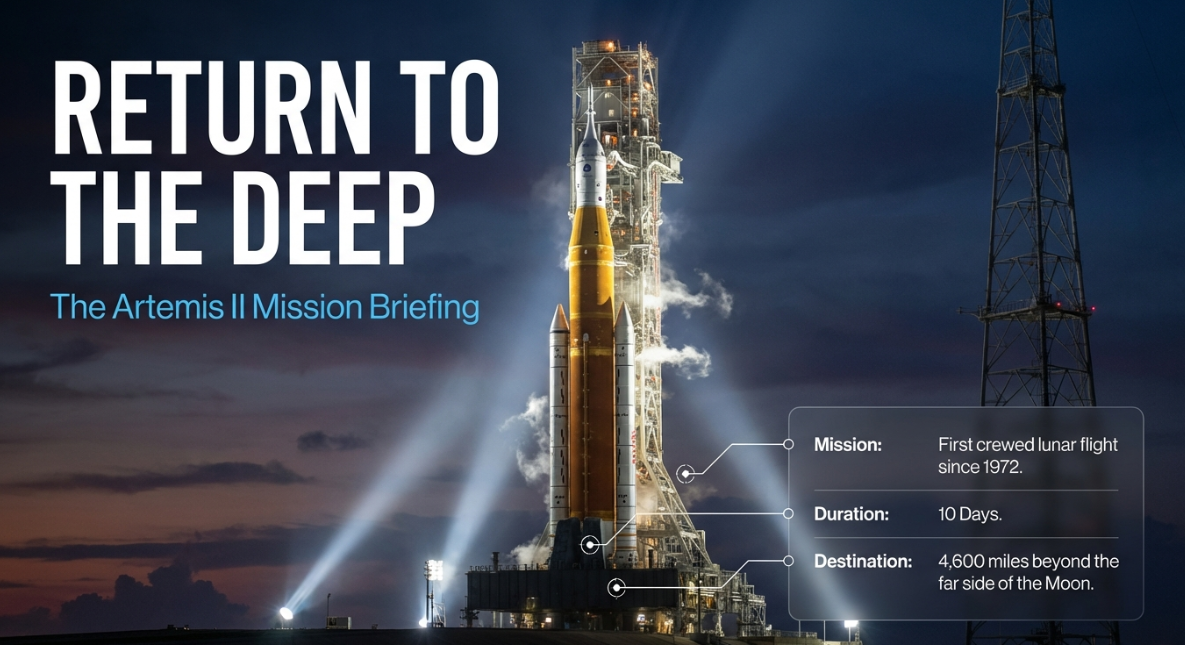
On April 1, 2026, a new chapter in human history is scheduled to begin.
For the first time since the departure of Apollo 17 in 1972, a crewed spacecraft will break the bonds of Low Earth Orbit and venture toward the Moon.
This is not a simple “re-run” of our 20th-century achievements.
Artemis 2 is a high-stakes validation of 21st-century aerospace engineering, serving as the bridge between the “flags and footprints” of the past and a permanent human presence in the solar system.
Here are five surprising realities of the mission that will redefine our relationship with the lunar frontier.
Why We Aren’t Landing (Yet)

It may seem counter-intuitive to travel 230,000 miles only to stop short of the surface, but Artemis 2 is a 10-day “crew-in-the-loop” test flight.
Before NASA commits to the Artemis 3 lunar landing, they must ensure the hardware is actually habitable for the long haul.
This mission marks the debut of the European Service Module’s (ESM) active life support capabilities.
Often described as the “heart and lungs” of the Orion spacecraft, the ESM-2 is responsible for supplying 90 kg of carried oxygen and distributing 240 kg of drinking water to the crew.
Rather than generating air on the fly, Orion will rely on these carried reserves to transform a cold test vehicle into a pressurized, living space for the four-person team.
“Artemis 2 is a crucial test flight, designed to prove that the Orion spacecraft and its life support systems can safely carry humans to the moon,” notes mission documentation.
Astronaut Christina Koch described the opportunity as an “incredible privilege and responsibility.”
The 40-Minute “Period of Loss”

One of the most psychologically heavy phases of the mission is the “Period of Loss.”
As Orion performs its lunar flyby, it will pass behind the far side of the Moon, placing a massive ball of rock between the astronauts and every other human being in existence.
For approximately 40 to 50 minutes, there will be a total data blackout.
Mission Control will lose everything: voice communication, 4K video feeds, and even the “vitals” or telemetry of the spacecraft.
This is a critical test of crew autonomy, forcing the astronauts to handle any potential anomalies independently until the spacecraft re-emerges from the lunar shadow.
High-Stakes Manual “Driving” in Deep Space

While modern spaceflight relies heavily on automation, Artemis 2 features a “Proximity Operations Demonstration” that demands elite manual skill.
Early in the mission, Commander Reid Wiseman and Pilot Victor Glover will take the controls to manually pilot the 13-ton Orion spacecraft.
Their target is the Interim Cryogenic Propulsion Stage (ICPS)—the discarded upper stage of the SLS rocket repurposed as a high-stakes “docking buoy.”
Using 24 reaction control thrusters, Wiseman and Glover will practice maneuvers essential for the complex docking procedures required for Artemis 3.
It is a moment of technical irony: using cutting-edge flight software to perform manual “driving” that validates human intervention as the ultimate failsafe.
4K Streaming from the Lunar Far Side

The grainy, staccato footage of the Apollo era is a relic of the past.
Artemis 2 will utilize the Orion Optical Communications System (O2O), a laser-based communication array capable of data transfer rates up to 260 megabits per second.
To put that in perspective, this is a massive leap over the kilobit-per-second speeds of the 1960s, allowing the crew to stream 4K ultra-high-definition video in near real-time.
This technology is designed to bridge the 250,000-mile gap, offering the public a “you are there” experience that turns a scientific mission into a global, shared human event.
The “Free Ride” Home

To ensure maximum safety, Artemis 2 will follow a “Free-Return Trajectory” that utilizes the Moon as a gravity assist.
After swinging around the far side, Earth’s gravity will naturally pull the spacecraft back home, requiring only minor course corrections rather than a massive, high-risk propulsion burn to exit lunar orbit.
During this journey, the crew will travel approximately 4,600 miles beyond the far side of the Moon, breaking the record set by Apollo 13 for the farthest humans have ever traveled from Earth.
From this record-breaking vantage point, the astronauts will witness a stunning perspective: the Moon appearing the size of a “basketball held at arm’s length” in the foreground, with the Earth a tiny, fragile marble 250,000 miles in the distance.
The Foundation for Mars
Artemis 2 is more than a voyage around a celestial neighbor; it is the foundation for a multi-planetary future.
By validating the SLS rocket and Orion’s life-support systems, NASA is preparing to move beyond Low Earth Orbit for good.
As we look toward the launch, we are forced to confront a profound question:
what will it mean for our species to finally see our own planet from the far side of the Moon again, not as a destination, but as a point of departure for Mars and beyond?
Leave a Reply