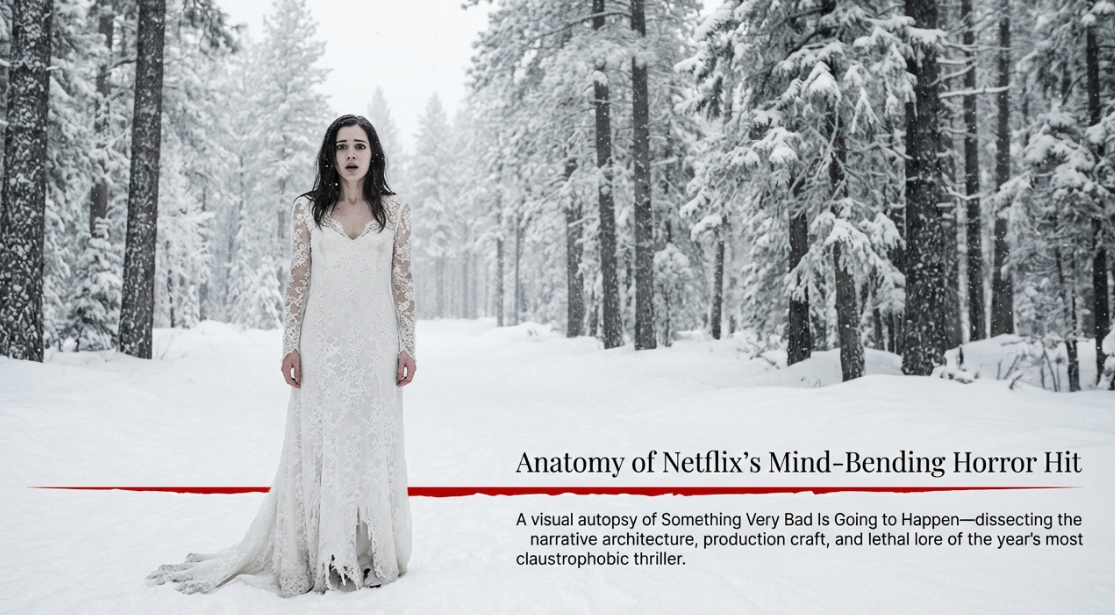
The “big day” has always been a culturally sanctioned pressure cooker, but Haley Z. Boston treats the domestic “I Do” as a legal binding to a charnel house.
Between the atavistic anxiety of meeting the in-laws and the crushing existential weight of a lifelong commitment, weddings are a goldmine for psychological collapse.
In Something Very Bad Is Going to Happen, Boston—the mind behind the psychosexual neon-noir Brand New Cherry Flavor—teams with executive producers the Duffer Brothers to transform this universal dread into a literal death march.
For the Duffers, this eight-episode limited series marks a pivot from the Amblin-soaked nostalgia of Hawkins to a cold, liminal “Gothic Expressionism.”
It’s a propulsive nightmare that asks: What if the person you’re about to marry isn’t just the wrong choice, but a terminal one?
It’s the “Final Boss” of Female Life-Stage Horror

Critics have lauded the series for completing a grim triptych of female-centric terror.
While horror has long mined the milestones of womanhood, Boston’s series targets the visceral terror of the “forever.”
Set within the Cunningham family’s isolated, snow-choked estate in Mississauga, the production utilizes a palette of faded colors and oppressive low light.
This isn’t just a default genre look; it’s a visual manifestation of a dying institution, framing the estate as a labyrinthine trap where wifehood is synonymous with erasure.
Jennifer Jason Leigh’s Victoria provides the thematic anchor here, chillingly describing marriage as an act of “sacrificing part of yourself.”
It is a sentiment that turns the Cunningham estate into a mausoleum for the self.
“If Carrie is horror’s version of a girl becoming a woman, and Rosemary’s Baby is the horrific version of a woman becoming a mother, Something Very Bad Is Going to Happen is horror’s take on a woman becoming a wife.” — Collider
The “Soulmate Curse” is a Brutal Narrative Trap

The series moves beyond standard pre-wedding jitters by weaponizing a lethal piece of family mythology.
Rachel (Camila Morrone) is ensnared by a bloodline curse: she must marry her soulmate or face a profuse, kinetic death involving hemorrhaging eyes and nose.
The “I Do or Die” stakes are compounded by a cruel mechanic: if the wedding is aborted, the curse transfers to the fiancé’s bloodline.
It strips away the sentimentality of the aisle, replacing it with a survivalist calculation.
The show’s most horrific irony lies with Nicky (Adam DiMarco).
In the finale, he abandons Rachel at the altar after his belief system is shattered by his mother’s infidelity.
Yet, when the bloodbath begins, Nicky survives while his married relatives perish. Why?
Because the curse is a narrative trap of perception: he still believes Rachel is his soulmate, even as he betrays her.
A Technical Masterclass in Disorientation

The series functions as a sustained, high-fidelity panic attack.
The technical craft is meticulously designed to mirror Rachel’s psychological unraveling through kinetic cinematography and a sonic landscape of absolute dread.
- The Score: Composed by Colin Stetson (Hereditary, The Menu), the soundtrack is a cacophony of sharp staccato notes and electric buzzes. Stetson’s signature “Hereditary-esque” dread is used to drown out character voices, effectively simulating sensory overload and isolating the viewer in Rachel’s internal collapse.
- The Cinematography: Bobby Shore and Krzysztof Trojnar reject formalist safety for disorienting angles and handheld “stalking shots.” The Cunninghams’ home is a character itself, defined by labyrinthine hallways and curving corridors that lead to a central atrium—an enchanting but inescapable courtyard that mimics a museum exhibit.
- The 1997 Sequence: Episode 4, “The Witness,” utilizes a naturalistic found-footage style for a pivotal home video sequence. It grounds the supernatural lore in a gritty, handheld reality that feels uncomfortably voyeuristic.
The Secret Casting of a Horror Icon

If you looked away for a second during Episode 4, you missed the season’s most devastating cameo.
In a brilliant “insider” reveal for prestige horror devotees, Victoria Pedretti (The Haunting of Hill House) appears unannounced as Rachel’s mother, Alexandra.
Pedretti’s performance provides the emotional anchor for the series’ most traumatic reveal: the origin of the “Sorry Man” legend.
We witness a young Julian (Jeff Wilbusch) hiding under a bed as his father, Jay, performs a frantic, bloody emergency procedure on Alexandra after she succumbs to the wedding-day curse.
This core trauma informs the “subtly twisted” ensemble. Ted Levine (forever a horror icon for The Silence of the Lambs) plays the patriarch Boris with a sinister, taxidermy-enthusiast edge, while Jennifer Jason Leigh’s narcissistic Victoria treats the marital curse with a regal, terrifying acceptance.
The “Witness” Twist and the Rebirth of Rachel

The finale delivers a staggering subversion of the “Final Girl” trope. After realizing Nicky is not her soulmate, Rachel chooses herself, refusing to complete the ceremony even as Nicky tries to slip the ring onto her finger in a desperate, last-second bid for safety.
Rachel temporarily dies—a sequence of stomach-churning body horror—only to be resurrected as the new “Witness.”
In the final moments, she encounters the child Jude and, with a chilling clarity, tells him she’ll see him at his wedding.
Before driving away from the Cunningham wreckage, she finds a note from the previous Witness, scrawled in blood: “You’re next.”
It is a passing of the torch that reframes her fate. While the ending is drenched in gore, showrunner Haley Z.
Boston frames it as a bittersweet triumph—the radical, terrifying freedom found in leaving a toxic relationship.
“Ultimately, by becoming the new Witness, she is reborn… she’s triumphant at the end, and she chooses herself.” — Haley Z. Boston
Until Death Do Us Part

Something Very Bad Is Going to Happen functions as a complete, self-contained tragedy, but Boston has already hinted at an anthology future.
Potential subsequent seasons would likely pivot to different “existential fears,” maintaining the same level of intellectual rigor and atmospheric rot.
As we watch Rachel drive into the snowy dark, we’re left to chew on the show’s central, provocative thesis:
Is there any concept more terrifying than a "soulmate" when the commitment is a literal death sentence? For Rachel, the only way to survive the "I Do" was to let herself die and be reborn as the observer of everyone else’s misery.
Leave a Reply