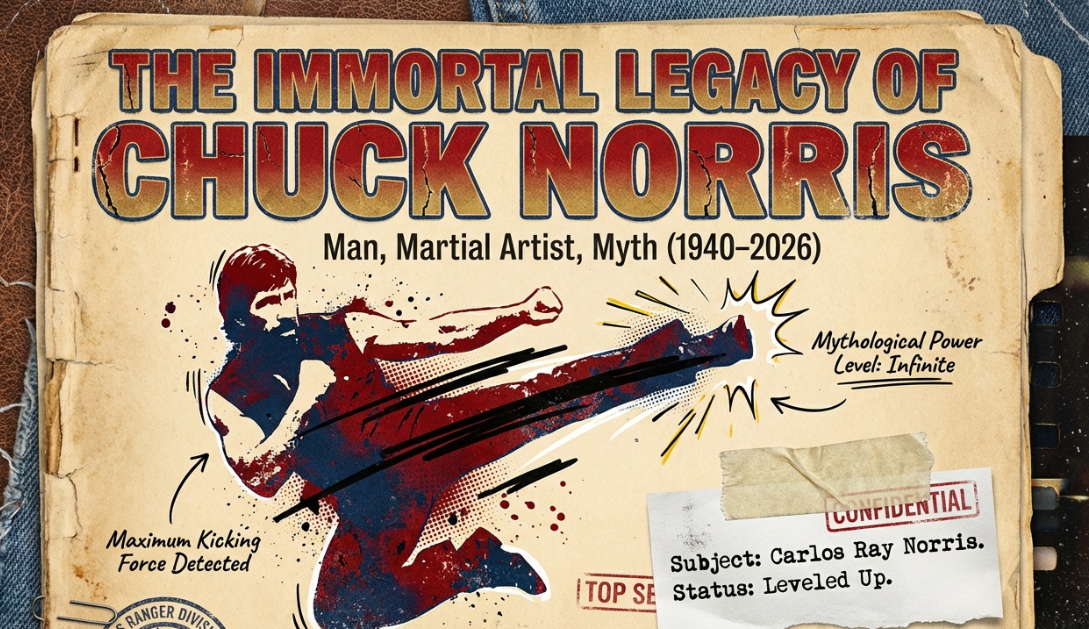
On March 19, 2026, a strange thing happened: reality finally caught up to Chuck Norris.
The news that the action icon had passed away at age 86 in Hawaii was met not with the hushed, somber tones usually reserved for the departure of a legend, but with a vibrant, digital roar of defiance.
To the world, he was the indomitable “Walker, Texas Ranger”; to his family, who described him as the “heart of our family” and a man of “faith and purpose,” he was a devoted husband and grandfather who passed “at peace.”
As a cultural historian, I find the dichotomy of this moment fascinating.
We are mourning a man who, for the last twenty years, the internet had collectively decided was immortal.
The contrast between the physical finality of a medical emergency in a Hawaiian hospital and the digital immortality of the man who supposedly “hand-delivered the doctor who delivered him” creates a unique space for reflection.
To truly honor Carlos Ray Norris, we must look past the hyperbolic beard and the “invincible” memes to see the disciplined, resilient, and surprisingly savvy individual who built a legacy that refused to be contained by a mere biological timeline.
Truth #1: The Only Man to Make Death Wait 20 Years

When a modern icon dies, the public usually retreats into nostalgia.
With Norris, the public pivoted to mythology.
The grieving process for the internet’s first “God-tier” meme was less an obituary and more of a “prestige” event.
Synthesizing the immediate reaction across digital spaces reveals a celebratory continuation of a myth that has become its own reality.
Fans didn’t see a man succumb to age; they saw a warrior who had simply “completed life” and was moving on to a new adventure.
The sentiment was summed up in a now-ubiquitous observation:
“Chuck Norris died 20 years ago… Death has only just built up the courage to tell him.”
The imagery was evocative and celebratory rather than mournful.
Fans speculated that “Death is expected to take 8 weeks to recover from his injuries,” or that Norris had simply “expelled the rest of us from his reality” to go see the “manager” of the next world.
Some even imagined the scene at the pearly gates, where St. Peter ushers him in only for Norris to calmly inform God, “You’re sitting in my chair.” This isn’t just humor; it is a cultural phenomenon where the subject has become so synonymous with toughness that death itself is treated as a tactical retreat by the universe.
Truth #2: From a Shy Teenager to a Six-Time World Champion

The myth of the “invincible” Norris often obscures the far more interesting truth: he was not a born athlete. As a teenager, Carlos was shy, non-athletic, and struggled with the instability of a home marked by his father’s alcoholism.
His transformation from a “shy kid” to a global symbol of dominance began as a file clerk in the U.S. Air Force, stationed at Osan Air Base in South Korea.
His early competitive career was actually quite rocky, a fact often omitted by those who assume he was born with a black belt.
However, the turning point came in 1967, when he refined his skill and defeated seven opponents in a single day. This grit paved the way for a legendary run:
- 1968–1974: Won six consecutive Professional Middleweight Karate championships.
- 1969: Captured karate’s Triple Crown and was named Fighter of the Year.
- Career Record: Compiled an estimated competitive record of 65–5.
This transition from a “non-athletic” youth to a world champion is the real-world foundation of his myth.
It wasn’t magic; it was the relentless application of discipline that took him from a backyard instructor in California to a chain-school owner training the likes of Steve McQueen and Priscilla Presley.
Truth #3: The Colosseum Duel—A Sacrifice for an Icon

While Norris appeared in his first film in 1968, his transition from “teacher” to “global icon” was forged in a meeting of martial arts royalty.
In 1972, Bruce Lee cast Norris as the antagonist in the climax of The Way of the Dragon.
As a cultural historian, I view this fight inside Rome’s Colosseum as a pivotal moment in action cinema.
But what is often overlooked is the physical sacrifice Norris made for Lee’s creative vision.
To fulfill Lee’s requirement that the antagonist look more physically imposing and “larger” than the lean, muscular protagonist, Norris intentionally gained significant weight for the role.
This wasn’t just a job; it was a collaborative effort between two friends and masters who respected each other’s craft.
That weight gain served as a visual shorthand for the “unstoppable force” archetype Norris would eventually inhabit for the rest of his career.
Truth #4: A Legacy Built on “Kickstart Kids”

The most surprising truth about a man known for “roundhouse kicking” his way through problems was his unwavering commitment to kindness and the character development of the next generation.
In 1990, Norris and his wife Gena founded Kickstart Kids (originally “Kick Drugs Out of America”).
While his screen persona was built on destruction, his real-world mission was construction—specifically, the building of “character through karate.”
The demographic was precise: middle and junior high school students in their most formative, vulnerable years. The statistics of this philanthropic engine are staggering:
- Reach: Since 1990, the program has impacted over 120,000 students.
- Scale: It currently serves between 8,000 and 9,500 students across 58–59 schools.
The family’s statement that he was a man of “faith and purpose” is validated here.
He leveraged his violent screen image to fund a non-profit dedicated to teaching focus, respect, and discipline. As his family noted:
“Through his work, discipline, and kindness, he inspired millions around the world and left a lasting impact on so many lives.”
Truth #5: The $30 Million Business Battle

Even for a man who “counts to infinity—twice,” the modern business of Hollywood proved to be a formidable opponent.
A counter-intuitive truth of Norris’s later years is that despite being a global superstar, he had to wage a massive legal war to protect his earnings.
In 2018, Norris’s company, Top Kick Productions, sued CBS and Sony for $30 million.
The dispute centered on Walker, Texas Ranger, the series that defined his career for nine seasons and over 200 episodes.
The lawsuit alleged that the studios failed to honor a contract promising Norris a 23% share of profits, particularly as the industry shifted toward streaming distribution.
This battle highlights the vulnerability of legacy stars in the digital age; even “Walker” himself had to struggle with modern profit-reporting structures and the opaque nature of streaming revenue models.
Truth #6: Strategic Brand Management—The “Fact Book”

When the “Chuck Norris Facts” phenomenon exploded in the mid-2000s, it could have easily parodied him into irrelevance.
Instead, Norris demonstrated a masterclass in brand management. Rather than resisting the parody or suing for the use of his likeness, he leaned in and turned a joke into a tool for longevity.
He authored The Official Chuck Norris Fact Book, a collection of 101 of his favorite “facts” and stories.
He used the persona to reach a new generation that had never seen Lone Wolf McQuade or The Delta Force.
By embracing the “invincible” label, he transformed a parody into a philanthropic tool, using the book’s success and the meme’s reach to keep his charitable causes funded and his name relevant in a digital-first culture.
He didn’t just survive the meme; he mastered it.
A Final Roundhouse for the Road

Chuck Norris lived his final years as a “Texas Legend” in the truest sense.
He resided on the 1,000-acre Lone Wolf Ranch in Navasota, Texas, which served as the operational base for his CForce Bottling Co., a business built around a sustainable aquifer discovered right on his property.
This image—the veteran warrior on a vast ranch, running a water company while practicing “character through karate”—provides a much more grounded and impressive portrait than any internet joke ever could.
He was a symbol of a specific, unwavering brand of American heroism: disciplined, resilient, and deeply rooted in faith.
As the dust settles on his final chapter in Hawaii, we are left with a career that spanned from the Korean War to the age of AI and viral memes.
If Chuck Norris didn’t actually die, but simply “decided to prestige at level 86” back to level one, what new challenges is he tackling in the next reality?
Whether he’s looking for his friend Bruce Lee or simply “waiting three days to see what happens,” his legacy remains a perfectly timed roundhouse kick to the face of the mundane.
Leave a Reply