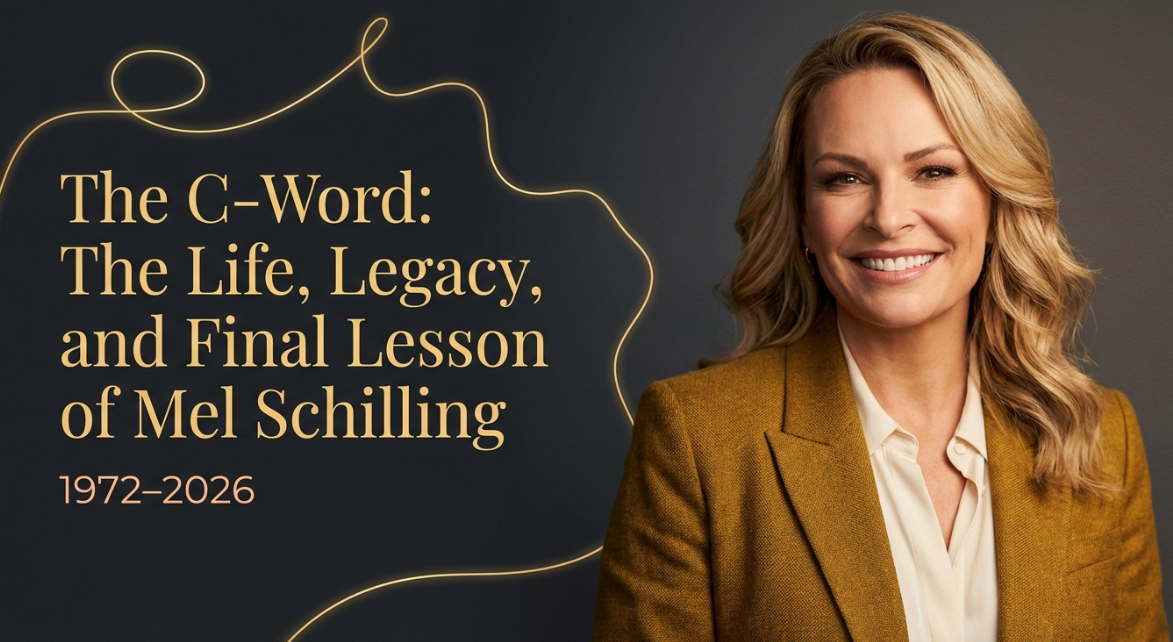
For over a decade, Mel Schilling occupied a unique space in the cultural zeitgeist as the “matriarch” of the global phenomenon Married at First Sight.
As a human behavior specialist, her voice was one of sonorous authority—empathetic yet unflinching—guiding strangers through the mercurial waters of modern intimacy.
She was the expert who taught a generation how to listen, yet her final chapter offered a more harrowing lesson: the cost of failing to listen to the “whispers” of one’s own body.
Mel’s public persona was defined by unshakeable optimism and a sophisticated, sharp-witted strength.
Privately, however, she was navigating a battle that would eventually transform her into a fierce advocate for health transparency.
Her journey, which concluded on March 24, 2026, leaves behind a legacy that transcends reality television, offering a masterclass in emotional bravery and the “skillset” of survival.
The Radical Act of the “Second Act”

Mel Schilling’s trajectory was a defiant challenge to the rigid, youth-obsessed narratives that often govern the entertainment industry.
She was a self-described “late bloomer,” a term she wore with a badge of honor rather than a hint of apology.
In a society that frequently views the “biological clock” as a countdown to obsolescence, Mel didn’t find her global platform—or her family—until her early 40s.
After twenty years as a psychologist and a decade navigating the Melbourne dating scene as a single woman, she met her husband, Gareth, through eHarmony at age 40.
By 42, she had simultaneously become a breakout television star and a first-time mother to her daughter, Madison, via IVF.
This timeframe was not a delay; it was a foundation.
Her “second act” was fueled by a maturity and perspective that younger stars rarely possess, proving that blooming late isn’t a race against time, but a deliberate evolution of self.
“This is a woman who became a new mum and a TV star at 42 – and nailed both,” her husband, Gareth, reflected. “To Maddie and me, she was our wee Melsie: an incredible mum, role model, and soulmate.”
Confidence as “Fluid Competence”

In her book, The C Word (Confidence), Mel stripped away the myth that self-assurance is an innate gift bestowed upon the lucky few.
Instead, she codified confidence as a “learned skillset,” an architecture of the mind built through practice and resilience.
She termed this “fluid competence”—the ability to maintain one’s agency and poise even when the ground beneath is shifting.
Mel didn’t just write the manual; she stress-tested it.
This mindset was the engine that allowed her to endure 16 rounds of chemotherapy while never missing a single day of filming.
To Mel, resilience wasn’t about the absence of fear, but about making friends with that fear to ensure it didn’t block the path to flourishing.
Her professional longevity during her illness was a testament to the idea that emotional bravery is a muscle—one that must be exercised before the crisis arrives.
Decoding the Body’s Silent Manifesto

Mel’s diagnosis was preceded by symptoms that are tragically easy to dismiss in the high-octane life of a global professional.
Before a scan in December 2023 revealed a tumor the size of a lemon in her colon—a mass she humanized with the nickname “Terry”—she experienced severe gut pain, weight loss, and an inability to hold down food.
Initially, she attributed these warnings to the grueling pace of international travel and “hormonal” fluctuations.
Her experience highlights a systemic sociological issue: the tendency for both women and the medical profession to “grin and bear” abdominal pain.
Mel spoke candidly about how women are conditioned to dismiss gut issues as part of a cycle or a “toughness” requirement.
Even as she was doubled over in pain during filming, she pushed through—a brand of professionalism that she later warned could be fatal.
Her advocacy became a lifeline for others, as she tirelessly promoted the use of the “FIT kit” (Faecal Immunochemical Test), an at-home screening tool for early detection.
“If I could leave you with one thing,” she urged her followers, “it would simply be this: if something doesn’t feel right, please get it checked out.”
Professionalism in the Face of the Terminal

The timeline of Mel’s battle was a grueling marathon. Following the removal of “Terry,” she was briefly given the “all clear” before the cancer metastasized to her lungs, and finally, by Christmas 2025, to her brain.
Throughout this, her work ethic remained extraordinary. She filmed 12 seasons of the Australian series and continued her work on the UK version, using her platform to partner with the charity Occtopus (the Oxford Colon Cancer Trust) to “demystify” the disease.
However, the final lesson in professionalism came when she recognized the need to let go.
In February 2026, as she was entering her 13th season of the Australian show, Mel made the “heartfelt decision” to step away.
It was a radical act of self-prioritization, choosing to place her family, her health, and her remaining time at the absolute center of her life.
The Nine Network noted her “unshakeable spirit,” but her greatest strength was knowing when the work of the heart had to take precedence over the work of the screen.
The Sustenance of the Final Whisper

Mel passed away at age 54, “surrounded by love.” In her final moments, when cancer had stolen her ability to speak with the ease she once had as a coach, she demonstrated the ultimate act of courage.
She summoned her remaining strength for one final, whispered message to Gareth and Maddie—a message intended to serve as their North Star.
Her family’s statement distilled her final advice into a manifesto for those she left behind: “Live life to the full, love your people well, and try not to sweat the small stuff.”
“In her final moments… she ushered me closer and whispered a message for Maddie and me that will sustain me for the rest of my life,” Gareth recounted. “It took all of her remaining strength, and that gesture summed up our wee Melsie perfectly.”
A Legacy of Emotional Bravery
Mel Schilling’s journey was a masterclass in the intersection of public grace and private grit.
She transitioned from a dating expert to a health advocate with the same directness that made her a household name.
By stripping away the “fear factor” of a terminal diagnosis and sharing the reality of her fading light, she offered a final, profound piece of advice on detection and the fragility of time.
Her life serves as a reminder that courage is not a gift we are born with, but a skill we must build.
As we reflect on her impact, we are left with the same urgency she shared in her final weeks: a call to stop and listen.
What is your body trying to tell you today that you might be too busy to hear?
Leave a Reply