For the cynical observer, the announcement of an HBO Harry Potter reboot felt less like a creative necessity and more like an industrial reflex.
We are, after all, still nursing the collective “post-Yates” exhaustion a lingering fatigue from the monochrome, increasingly desaturated visuals that defined the later films.
Yet, the recent reveal of the Max Original series suggests something far more ambitious than a simple retread.
By tapping the creative marrow of Succession—specifically showrunner Francesca Gardiner and director Mark Mylod—HBO is signaling a pivot toward “prestige TV” in its truest sense.
This isn’t just about longer runtimes; it’s an attempt to trade the “circus dressing room” theatricality of the early 2000s for an organic, lived-in world.
As a critic, the interest lies not in the nostalgia, but in the “Succession DNA” being grafted onto the Wizarding World: a focus on family rot, political maneuvering, and a tangible sense of place.
Takeaway 1: “Naturalism” is the New North Star

Director Mark Mylod has officially declared “naturalism” as the series’ guiding light, a direct rebuttal to the stylized, often over-exaggerated aesthetic of the film franchise.
In a landscape where high-fantasy adaptations often slide into the “clinical” and emotionally distant think the early seasons of His Dark Materials—Mylod’s challenge is to maintain the books’ inherent whimsy without sacrificing dramatic gravity.
Critically, “naturalism” here does not mean “gritty” or “colorless.” Lead Director of Photography Adriano Goldman (an Emmy winner for The Crown) has explicitly promised a “vibrant” visual approach.
The goal is a tangible world one where the magic feels like a part of the physics of the environment rather than a post-production afterthought.
“The show will focus on naturalism as opposed to the stylism of the films.” — Mark Mylod
Takeaway 2: The “Canonical” Age Correction

The most significant narrative correction comes via the casting office.
For years, the “Marauders’ generation” has been viewed through the lens of actors who were decades older than their literary counterparts.
By casting Paapa Essiedu as a 31-year-old Severus Snape, HBO is finally honoring the tragic timeline of the first Wizarding War.
In the books, Lily and James Potter were only 21 when they died.
Seeing a Snape who is barely a decade removed from that trauma adds a layer of raw, “prestige-drama” immediacy that was lost in the older, more distinguished portrayals of the past. Meanwhile, the central trio—Dominic McLaughlin (Harry), Alastair Stout (Ron), and Arabella Stanton (Hermione)—have been cast at the canonical age of 11.
Because HBO is committing to a ten-year production cycle with back-to-back filming, we will witness these actors age in real-time, lending a documentary-like weight to their journey from childhood to the front lines of a war.
Takeaway 3: Eight Episodes for One Book

The shift to long-form storytelling is the series’ greatest weapon against the “greatest hits” pacing of the films.
The first season, adapting The Philosopher’s Stone, will consist of eight episodes. Notably, HBO is opting for the original British title for all global markets, a subtle but firm nod to book purists.
With eight hours to cover a single novel, the production can finally explore the “crevices” of the narrative.
This includes the Hogwarts staffroom and the complex social hierarchy of the faculty.
The decision to cast Johnny Flynn as Lucius Malfoy in Season 1 despite the character’s negligible presence in the first book is a masterstroke of long-term planning.
It suggests that Gardiner is positioning the series as a political thriller from the jump, establishing the Malfoy family’s corrosive influence on the Ministry of Magic years earlier than the films ever dared.
Takeaway 4: The Return of the Forgotten (Peeves and Beyond)

In a move that serves as a peace offering to the fandom, the series has confirmed that Peeves the Poltergeist will finally make his screen debut.
While the character was famously excised from the 2001 film, his inclusion here is symbolic of a deeper commitment to the “complete” text.
Reclaiming characters like Peeves signals that this adaptation isn’t just looking for the emotional beats; it’s looking to build a comprehensive, functional society.
Takeaway 5: A Visual Redesign from Scratch

HBO is aggressively distancing itself from the Warner Bros. Discovery “theme park” aesthetic. The redesign is comprehensive:
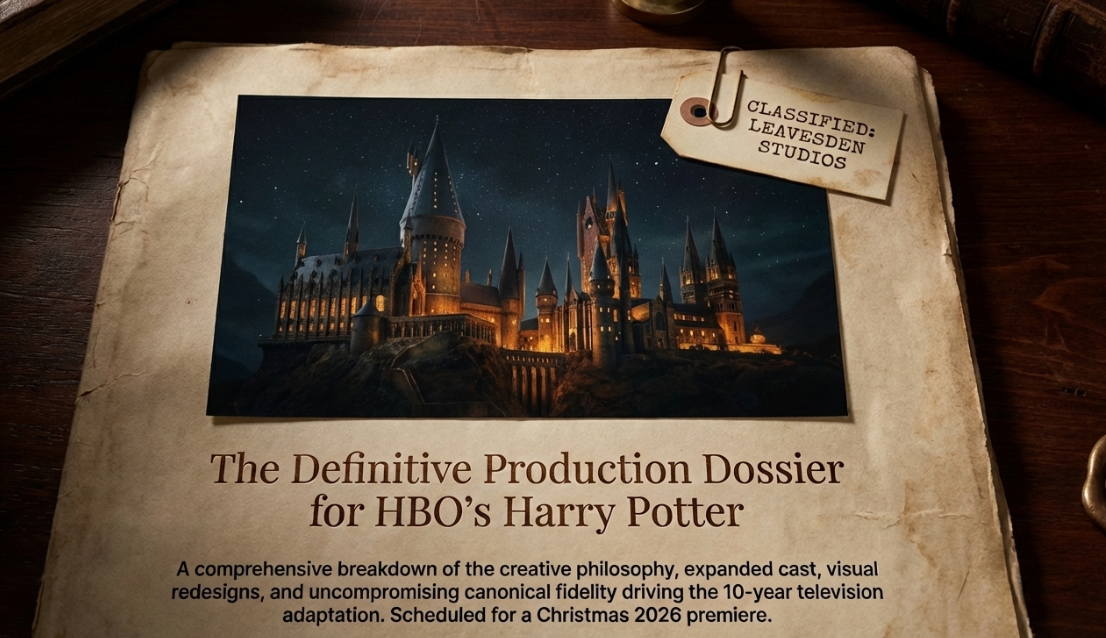
- Architecture: Hogwarts is moving toward “Georgian architecture” inspiration, with a new crest that resembles “trees growing”—a visual metaphor for the “naturalism” Mylod is chasing.
- The Boy Who Lived: Harry’s lightning-bolt scar has been redesigned with a more organic, “squiggly” end. His glasses are now a tortoise-shell colorway, and the trailer even hints at book-accurate quirks, such as Petunia Dursley hacking off Harry’s hair only for it to grow back instantly.
- The Action: Quidditch is being reimagined with “F1-style” camera angles to emphasize the speed and danger of the sport. Even the brooms are different; the Nimbus 2000 now features a “flat” tail design that looks like a bundle of three or four brooms tied together—a utilitarian departure from the sleek, polished movie props.
Takeaway 6: A Masterclass in Prestige TV Casting

The adult ensemble reads like a “who’s who” of high-caliber character actors, further aligning the project with the production pedigree of Game of Thrones.
With John Lithgow as Dumbledore, Janet McTeer as McGonagall, and Nick Frost as Hagrid, the faculty feels grounded in gravitas rather than just “British acting royalty” cameos.
Paapa Essiedu, in particular, brings a modern intensity to Snape, navigating the inevitable scrutiny with a grace that echoes the character’s own guarded nature.
“The themes that run through Harry Potter are of love triumphing over hate – of acceptance. And that’s why I’m doing it.” — Paapa Essiedu
Takeaway 7: The Christmas 2026 Countdown
Despite earlier projections of a 2027 start, the first trailer has locked in a Christmas 2026 debut on Max.
This aggressive timeline, paired with the “back-to-back” filming strategy for Season 2, confirms HBO’s massive decade-long commitment.
This is the “ten-year project” in motion, designed to be the definitive screen version for a generation that values thematic weight over theme-park aesthetics.
A Lived-In Wizarding World
The HBO reveal confirms a fundamental shift in the Harry Potter screen legacy.
We are moving away from the heightened, theatrical stylings of 20th-century fantasy toward a more grounded, organic, and lived-in world.
As Jason Isaacs, the original Lucius Malfoy, noted regarding the redesign:
“They’re redesigning everything from scratch… it’ll be for a new generation. It’ll be their version of Harry Potter… now I can watch them with unalloyed fandom.”
The question remains:
In our quest for "naturalism" and a "grounded" fantasy, is the fandom truly ready for a Potter that prioritizes thematic weight over the comfort of stylized whimsy? Christmas 2026 will provide the answer.
Leave a Reply