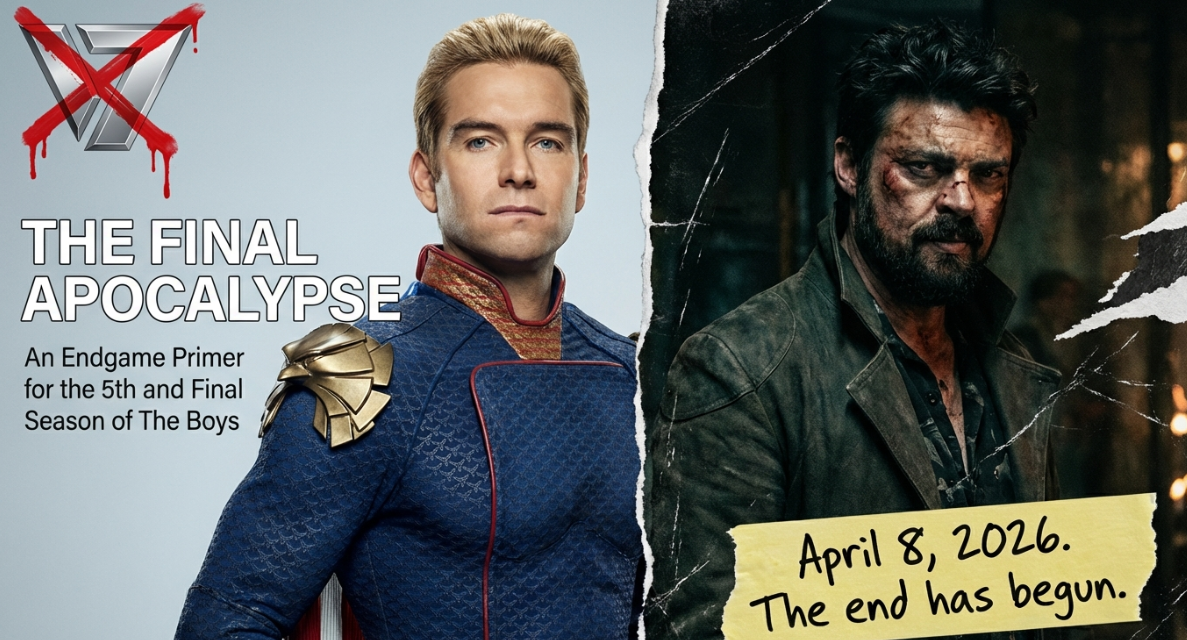
The wait for the end of the world is finally over.
On April 8, 2026, Prime Video unleashed the first two episodes of the fifth and final season of The Boys, immediately plunging the audience into what showrunner Eric Kripke has termed the “show’s version of the apocalypse.”
The status quo is officially shattered: Homelander has achieved absolute, unfettered power, controlling the U.S. government through a puppet administration, while the titular Boys are scattered, broken, and hunted.
As a narrative analyst, the two-part premiere—”Fifteen Inches of Sheer Dynamite” and “Teenage Kix”—offers a masterclass in diabolical symmetry and visceral consequence.
Here are the five most shocking takeaways from the final season’s debut.
Redemption through Deceleration: The Death of A-Train

In a series built on subverting superhero tropes, Reggie Franklin’s (A-Train) exit was a breathtaking structural bookend.
The premiere delivers a high-speed action sequence that is a direct, mocking parody of the iconic “Time in a Bottle” Quicksilver scene from X-Men: Days of Future Past.
But where Marvel gave us whimsical slow-motion heroism, Kripke gives us a tragedy of momentum.
A-Train finally chooses to be an “actual real hero,” intervening to save Hughie Campbell from Homelander’s heat vision.
The poetic irony is agonizing: in the series pilot, A-Train’s refusal to stop resulted in the accidental death of Hughie’s girlfriend, Robin.
Here, during a high-speed chase through the woods, A-Train narrowly avoids a female bystander.

That split-second decision to value a human life causes him to lose his momentum and crash—the very deceleration that allows Homelander to catch him and snap his neck.
Antony Starr’s reflection on the scene highlights Homelander’s psychological defeat in the face of physical victory: “A-Train hits a nerve and ultimately… becomes an actual real hero.
[Homelander] reveals a vulnerability and a loss.” By choosing to die for a bystander, A-Train proved that a Supe can transcend Vought’s programming, a reality that leaves Homelander more isolated than ever.
Kimiko’s Agency and the TikTok Meta-Commentary

One of the most profound shifts in the series’ DNA is Kimiko Miyashiro finding her voice.
While her vocal ability first manifested as an anguished scream during Frenchie’s abduction in the Season 4 finale, the Season 5 premiere establishes her transition into full, verbal agency.

In a characteristically cynical and modern twist, the show explains that Kimiko used TikTok to help her transition into regular speech.
There is a brilliant, meta-commentary here: a character deeply traumatized by Vought’s corporate experimentation regains her voice through a Vought-adjacent social media platform.
While the show uses her verbal brashness for comic relief, it represents a positive step toward trauma healing.
Kimiko is no longer merely Butcher’s mute weapon; she is an expressive leader of the resistance who chooses her battles, rejecting the dehumanization that has defined her life.
Homelander’s “Pyrrhic Victory” and the Body Horror of Politics

Homelander has never been more powerful, nor more profoundly miserable.
Now commanding the military and the executive branch, he has installed Ashley Barrett as the new Vice President.
In a grotesque display of the show’s signature body horror, Ashley’s injection of Compound V has resulted in her “rear face” gaining consciousness—a literal manifestation of the two-faced nature of authoritarian politics.
Despite this control, Homelander is “broken” and “damaged,” disgusted by his own lingering humanity.
As Eric Kripke noted, Homelander is trapped in a vicious cycle: he believes more power will bring fulfillment, only to find that it increases his isolation.
His execution of A-Train wasn’t just a purge of a traitor; it was a desperate attempt to destroy a mirror of his own insecurity.
Homelander is no longer a villain striving for a goal; he is a man at the top of a mountain, realizing there is nothing there but his own self-loathing.
The Cryogenic Wildcard: Soldier Boy’s Awakening

While fans were already buzzing about the Supernatural reunion—with Jared Padalecki and Misha Collins joining Jensen Ackles, Jeffrey Dean Morgan, and Kripke—the premiere’s biggest “shocker” was the context of Soldier Boy’s return.
In Episode 2, Homelander awakens his biological father from cryostasis, ordering him to hunt down Billy Butcher in exchange for clearing his name.
Soldier Boy is no longer just a series regular; he is a volatile wildcard.
This move resets the emotional stakes to a “father-son” dynamic that Kripke admits they never fully explored in Season 3.
Soldier Boy’s mission to kill Butcher—who betrayed him—creates a three-way collision course between the Boys’ vengeance, Homelander’s desperation, and a legendary Supe who has nothing left to lose.
The Gen V Resistance and the Virus’s Lethality

The integration of the Gen V spin-off has moved from “Easter egg” to “essential endgame.”
Starlight is now the face of an underground resistance, aided by Marie Moreau and her Godolkin classmates.
However, the premiere clarifies the high stakes of this “Supe Civil War,” as former allies Cate Dunlap and Sam Riordan remain initially aligned with Vought’s fascist regime.
The true horror of the premiere lies in the testing of the Supe Virus.
In Episode 2, we witness the virus’s devastating potential as it is tested on Rock-Hard and other members of the Teenage Kix group.
The resulting death of Jetstreak serves as a grim proof of concept for Butcher’s endgame. Butcher has fully embraced his “monster side,” willing to commit total Supe genocide—even at the cost of his own life—to ensure Homelander’s destruction.
As Kripke warns, “anyone who dies in season five will richly deserve it,” signaling that the moral gray areas have been replaced by a scorched-earth policy.
Landing the Plane in a Hopeless World

As we move toward the series’ “moist, epic climax,” the central theme of Season 5 is clear: the struggle to maintain hope amid “creeping authoritarianism.”
Eric Kripke has spoken candidly about his “terror” of failing to “land the plane,” a fear that reflects the high pressure of concluding such a culturally poignant satire.
The premiere asks a daunting question: In a world where the monsters have won the election and own the law, is the human ability to get back up after being knocked down enough?
With the “show’s version of the apocalypse” now in full swing, the Boys aren’t just fighting for survival—they’re fighting for the very soul of humanity in a world that has “drunk Homelander’s Kool-Aid.”
Leave a Reply