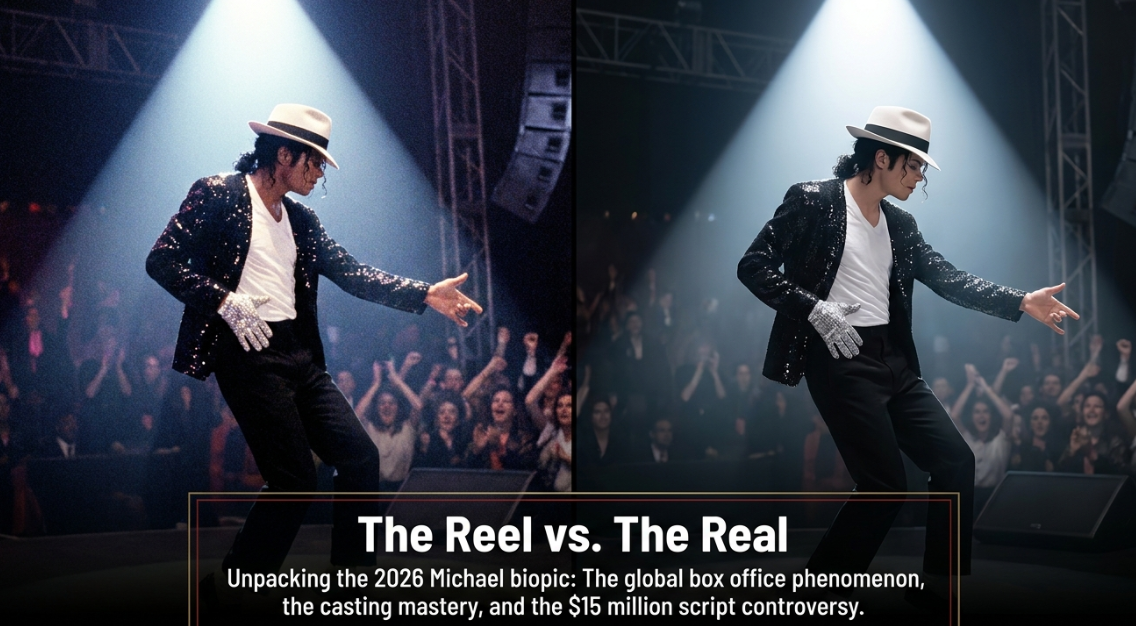
On April 24, 2026, Antoine Fuqua’s Michael moonwalked into theaters, not just as a film, but as a high-stakes corporate gamble.
Carrying a budget that ballooned from $165 million to a reported $200 million following extensive reshoots, the biopic has exposed a cavernous rift in the cultural landscape.
As of its opening, the film sits at a dismal 40% Tomatometer score—yet audiences have fired back with a staggering 96% on the Rotten Tomatoes Popcornmeter.
This 56-point delta is a middle finger to the critical establishment, proving that the Jackson brand operates in a vacuum of nostalgia that the press cannot touch.
For the industry strategist, Michael is the ultimate “critic-proof” product: a $200 million shield forged from 13 iconic tracks and a carefully managed legacy.
The Mystery of the Missing Third Act: Why the Allegations Were Scrubbed

The version of Michael currently playing in IMAX is not the version originally written. Early drafts of the script by John Logan took the narrative into the dark heart of the 1990s.
In fact, a “lost opening” was originally filmed that began in medias res in 1993, showing Michael staring at his own reflection as police arrived at Neverland Ranch to execute a search warrant.
The production eventually hit a legal wall that no amount of Hollywood leverage could scale.
A clause buried in the $25 million settlement Jackson reached with Jordan Chandler in 1993 specifically forbade the depiction of Chandler in any film or television production.
Faced with a legal catastrophe, the estate funded $10 million to $15 million in reshoots to scrub the allegations entirely.
The final cut now ends abruptly in 1988 at the height of the Bad tour, effectively amputating the most controversial decades of Jackson’s life to protect the broader brand.
“Fuqua might’ve had some cameras and microphones on hand to produce moving images and sound for this estate-approved King of Pop biopic.
But make no mistake about it: Michael isn’t a movie. It’s a filmed playlist in search of a story.” — Robert Daniels, RogerEbert.com
Bloodline Authenticity: Jaafar Jackson’s “Uncanny” Transformation

The strategist’s most brilliant move was casting from within. Jaafar Jackson, Michael’s real-life nephew, carries the weight of this $200 million production in his film debut.
After a grueling two-year casting process, Jaafar has delivered a performance that even the most cynical critics are calling “Oscar-worthy.”
Reviewers have noted his “electrostatic moves” and a haunting ability to channel the specific blend of “delicacy and steel” that defined his uncle.
It is a performance that provides the emotional anchor the script otherwise lacks. Katherine Jackson, the family matriarch, has publicly validated the transformation, stating that Jaafar “embodies” her son in a way that transcends mere acting.
A Family Divided: The Silent Sister and the Legal Filing

While the film’s marketing leans heavily on family unity, the reality behind the scenes is fractured.
Prince Jackson served as Executive Producer, providing the estate’s stamp of approval, but his sister Paris Jackson has remained a vocal and strategic detractor.
Paris didn’t just call the script a “Hollywood fantasy” and “dishonest”; she took it to the courts. She filed a legal claim against estate executors John Branca and John McClain over the casting of Miles Teller as Branca. Her argument?
That Branca was using the film to “enrich and aggrandize himself” by making his character central to the Michael Jackson story.
Meanwhile, Janet Jackson’s absence is the loudest part of the room; the superstar simply declined to be portrayed, a move a strategist recognizes as a calculated distancing from a “sanitized” corporate narrative.
More Than a Movie: The Global Spectacle Strategy

The marketing for Michael has treated the film as a religious event rather than a cinematic release.
The teaser trailer alone racked up 116.2 million views in 24 hours, shattering the record previously held by Taylor Swift: The Eras Tour.
To maintain this “truth,” the production leaned into hyper-authenticity in its locations:
- Neverland Ranch: Filmed on the actual 2,700-acre estate in Los Olivos.
- The Origins: Scenes at the Jackson family’s Hayvenhurst home in Encino.
- Iconic Stages: The “Motown 25” sequence was shot at the Pasadena Playhouse, and the “Thriller” zombie sequence was reshot at its original 1983 locations on Union Pacific Avenue and S Calzona Street in Los Angeles.
This commitment to physical reality serves as a distraction from the narrative omissions, using the geography of Jackson’s life to validate a story that stops before the tragedy begins.
Record-Breaking Hype and the Sequel Inevitability

Despite the 40% critic score, Michael is tracking for a massive $140 million to $150 million global opening weekend.
The internal target for Lionsgate is $700 million worldwide—a figure that would cement it as the king of musical biopics.
From a strategic standpoint, the “sanitized” ending is less of a creative choice and more of a franchise setup. With 30% of the original material—including the deleted scenes regarding the 1993 allegations—sitting in the vault, a sequel is already a corporate inevitability.
Lionsgate executives have hinted they are “making sure they are in a position to deliver more Michael soon.”
The Future of the MJ Franchise

At its core, Michael is a middle-of-the-road biopic that prioritizes the “concert-like spectacle” of a filmed playlist over deep biographical inquiry.
It delivers a nostalgic high while leaving the most complex questions of Jackson’s legacy unanswered.
As the film moves toward its $700 million goal, we are left with a sobering reality for the future of the genre:
Can we ever truly separate the man from the music, or is a "sanitized" legacy the only way Hollywood knows how to sell a legend to the masses?
Leave a Reply