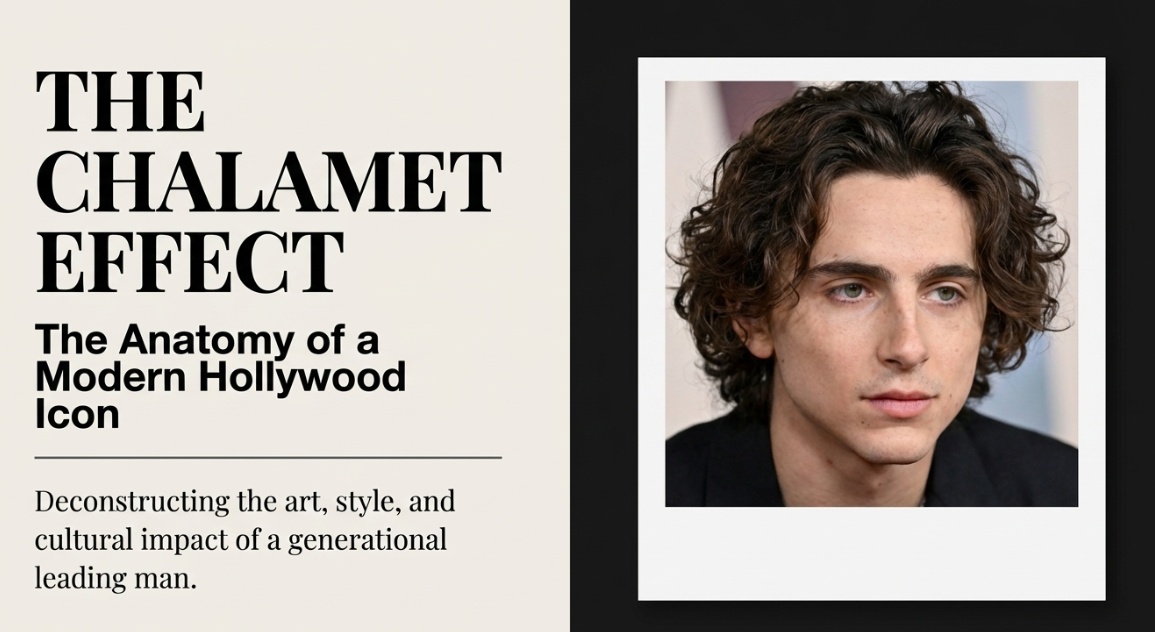
In the span of a few breakneck years, the cultural calculus surrounding Timothée Chalamet has undergone a total recalibration. We have transitioned from the era of the waifish indie darling in oversized suits to witnessing the most formidable sartorial and cinematic force in the modern industry.
Looking back from the vantage point of 2026, the “Chalamet Phenomenon” has moved past bejeweled harnesses and blockbuster box office into something far more metatextual.

Beneath the high-fashion semiotics lies a dedicated craftsman who has fundamentally disrupted the Hollywood leading man archetype. What exactly fueled this evolution from heartthrob to the “Greats” territory he now inhabits?
The “Beady Eye” Method, Sensory Deprivation as Craft

While Chalamet’s peers often rely on dramatic weight fluctuations to telegraph “seriousness,” his preparation for the 2025 auteurist triumph Marty Supreme took a more cerebral, counter-intuitive approach to physical transformation.
To inhabit table-tennis legend Marty Mauser, Chalamet didn’t just carry a ping-pong table to every set for seven years—including the sprawling dunes of Arrakis—he opted for a “life of impairment.”
Chalamet wore high-prescription contact lenses specifically designed to blur his vision, then wore real glasses over them to correct his sight back to baseline.

This wasn’t just for the “beady-eyed” aesthetic it provided the camera; it was a sensory deprivation technique mirroring the technical precision of a Daniel Day-Lewis.
By choosing to navigate the world through a haze of technical correction, he accessed a specific, weathered edge that secured him both a Golden Globe and a Critics’ Choice Award in 2025.
“It got me into the world of Marty Reisman, who’s living sort of a life of impairment. At risk of being pretentious, it’s like if you gave an artist three colors instead of nine and said—do a rainbow.”
The Messiah Subverted, A Gritty Forecast for Dune: Part Three

As we approach the December 2026 release of Dune: Part Three, the casting narrative confirms Denis Villeneuve’s long-held ambition: to dismantle the “Messiah” myth entirely.
Shifting 12 years past the initiation of the Holy War, the finale introduces a Paul Atreides who has fully pivoted into anti-hero territory.
The casting is a masterclass in subversion. Jason Momoa returns as a Duncan Idaho ghola, while Robert Pattinson joins as the Tleilaxu Face Dancer Scytale, the architect of Paul’s potential dethroning.
Most telling is the introduction of Paul’s children, Leto II and Ghanima Atreides, played by Nakoa-Wolf Momoa and Ida Brooke.
These additions signal a narrative that prioritizes the tragic weight of legacy over the typical hero’s journey, forcing Chalamet to play a man crushed by the very destiny he once sought to master.
“Affective Masculinity”—The Disruptive Power of Softness
Chalamet’s star image has become a primary case study for what academics call “affective masculinities.”
In this framework, tenderness, vulnerability, and—crucially—silence are treated as vectors of power rather than deficits of strength.
His “waifish” frame and gentle facial traits allow him to bypass the traditional macho prototype, creating a hybrid male subject that blurs the lines of hegemonic masculinity.
This is not merely a performance of sensitivity; it is a fundamental disruption of the Hollywood “strong, silent type.”
In Chalamet’s hands, silence becomes an active, emotional space—seen in the haunting final frames of Call Me by Your Name and the weathered exhaustion of his SAG-winning turn as Bob Dylan in A Complete Unknown.
“Affect may help produce some new kind of feeling male subject not yet culturally defined.”
Safdie Chaos Vulnerability, Spankings, and Vampire Dreams
There is a direct line between the internal vulnerability of “affective masculinity” and the physical vulnerability Chalamet displayed on the set of Josh Safdie’s Marty Supreme.
The film, which became A24’s highest-grossing release at $162.3 million, was famously fueled by Safdie’s “Uncut Gems energy.”
This manifested in a notorious scene where Chalamet’s character receives a public spanking; Chalamet refused a stunt double, insisting on the real thing.
When the prop paddle shattered on the first take, Safdie substituted a real wooden paddle for the remaining shots.
The set was so steeped in grit that co-star Gwyneth Paltrow was famously deceived by Michael Fontaine’s makeup work.
Seeing the pockmarks and nicks designed to give Chalamet a “street” appearance, she reportedly pulled him aside to suggest micro-needling for his “acne scars.”
Perhaps most bizarre was the rejected ending Safdie and Chalamet championed: a 1980s-set finale where Kevin O’Leary’s character is revealed to be an actual vampire.
Though studio execs vetoed the supernatural twist, the willingness to flirt with such gonzo calamity defines Chalamet’s current auteurist era.
The Manhattan Plaza DNA – A Built-In Artistic Pedigree
Chalamet’s ability to pivot from a Nike-clad Zoom call prank to the high-culture prestige of the Cannes Film Festival is no accident; it is encoded in his artistic DNA.
Raised in Manhattan Plaza, the legendary federally subsidized artist housing, Chalamet is a third-generation New Yorker with a multicultural lineage that provides him with an effortless bilingualism and a “supreme vision” for his career.
With a mother who was a Broadway dancer and a father who was a French journalist for UNICEF, Chalamet’s upbringing was a blend of American discipline and European intellectualism.
This background explains his mastery of sartorial semiotics—the way he uses fashion not just as clothing, but as a metatextual performance that extends the life of his characters long after the cameras stop rolling.
The Final Thought
As Chalamet cements his place in the pantheon of “the greats,” his true power lies in his refusal to be categorized.
Whether he is scaling the Las Vegas Sphere in a CashApp-funded stunt or parodying corporate narcissism in a viral A24 “Zoom call,” he treats the marketing of his films as an extension of the performance itself.
He has become the rare actor whose vulnerability is his greatest armor. As he concludes the Dune trilogy and moves beyond the prestige of his 2025 awards sweep, one question lingers:
is Hollywood ready to follow his lead into a more "affective" era of the leading man, or is Chalamet a once-in-a-generation anomaly that the industry can admire but never truly replicate?
Leave a Reply