

A friend recently asked me which AI writing tools he should buy.
I asked him a different question.
“What are you trying to write?”
Because that’s the problem with most AI comparisons.
They assume there’s one tool that’s best at everything.
There isn’t.
Some AI tools are fantastic at blog posts.
Others are built for marketing teams.
Some are great at editing.
Others should probably stay away from your important documents.
After spending the last couple of years testing nearly every major AI writing tool, here’s the advice I’d give someone spending their own money.
The Short Answer
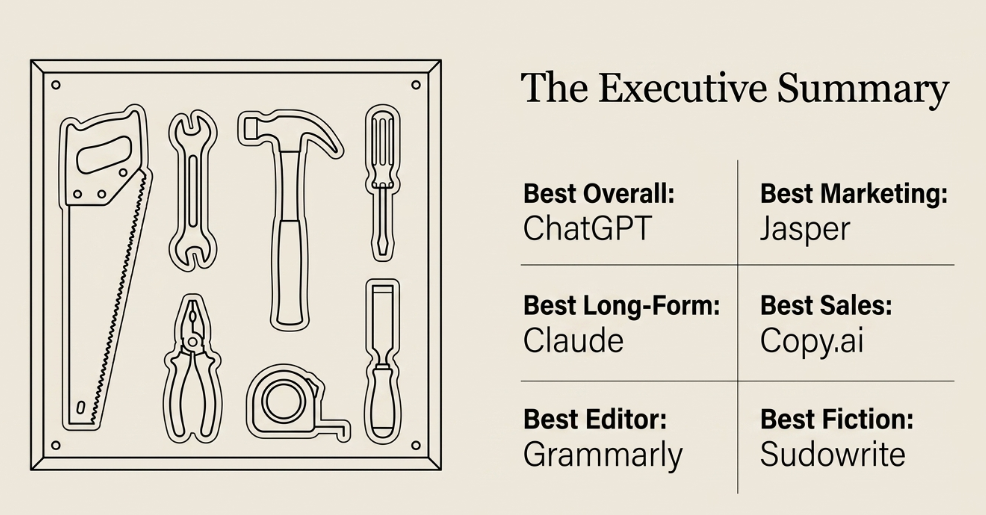
If you’re in a hurry, here’s my ranking.
Best Overall: ChatGPT
Best for Long-Form Writing: Claude
Best for Marketing Teams: Jasper
Best Free Option: ChatGPT (Free)
Best Grammar & Editing: Grammarly
Best for Sales Copy: Copy.ai
Best for Creative Writing: Sudowrite
Now let’s talk about why.
1. ChatGPT
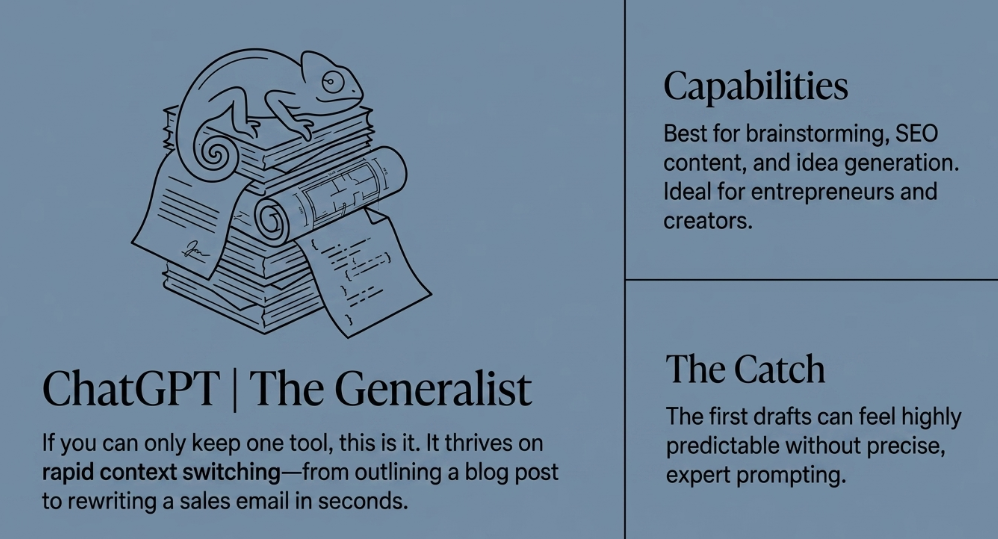
Best Overall
If I could only keep one AI writing tool, this would be it.
Not because it’s perfect.
Because it’s incredibly flexible.
One minute you’re outlining a blog post.
The next you’re rewriting a sales email.
Then you’re brainstorming product names.
Few tools switch contexts this well.
Strengths
- Blog writing
- Brainstorming
- Email drafting
- SEO content
- Social media
- Business writing
- Idea generation
Weaknesses
Sometimes the first draft feels a little predictable.
Fortunately, good prompts usually fix that.
Best For
Entrepreneurs.
Freelancers.
Content creators.
Small business owners.
2. Claude
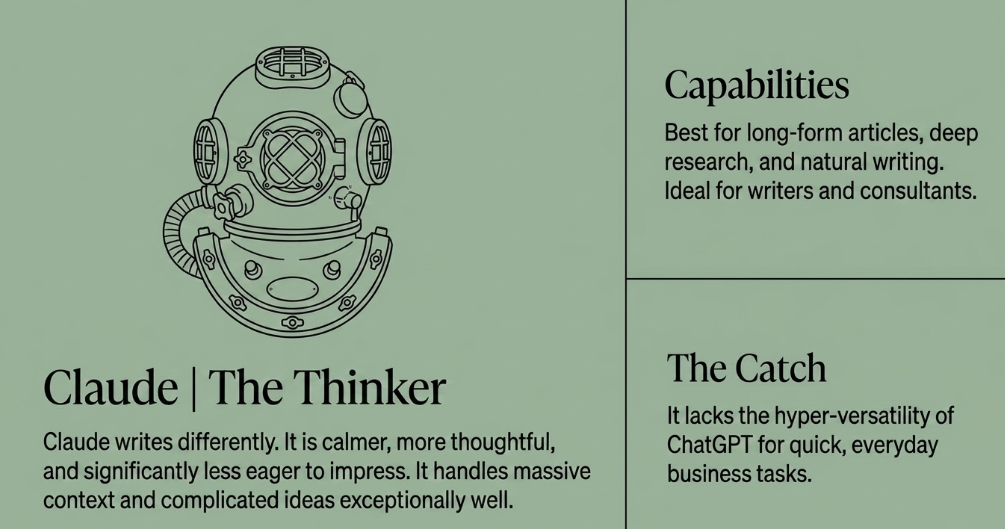
Best for Long-Form Content
Claude writes differently.
It’s calmer.
More thoughtful.
Less eager to impress.
When I’m working on a long article or trying to organize a complicated idea, Claude is usually where I start.
It handles context exceptionally well.
Strengths
- Long-form articles
- Reports
- Research
- Editing
- Natural writing
Weaknesses
It isn’t as versatile as ChatGPT for everyday business tasks.
Best For
Writers.
Consultants.
Researchers.
Anyone producing in-depth content.
3. Jasper
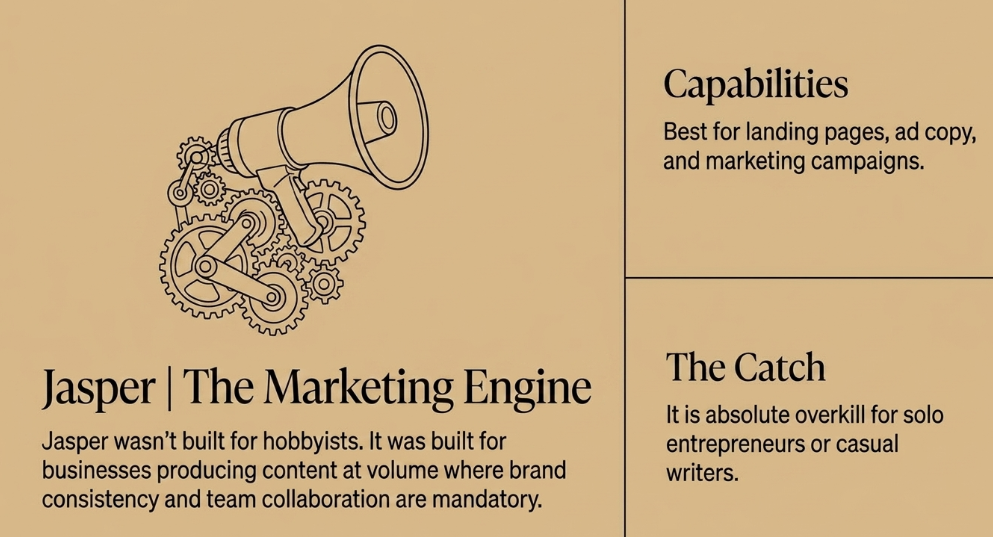
Best for Marketing Teams
Jasper wasn’t built for hobbyists.
It was built for businesses producing a lot of content.
Think:
- Landing pages
- Product descriptions
- Ad copy
- Marketing campaigns
- Email sequences
If content is part of your company’s workflow, Jasper starts making more sense.
Strengths
Marketing workflows.
Brand consistency.
Team collaboration.
Weaknesses
It’s overkill for most solo entrepreneurs.
4. Copy.ai
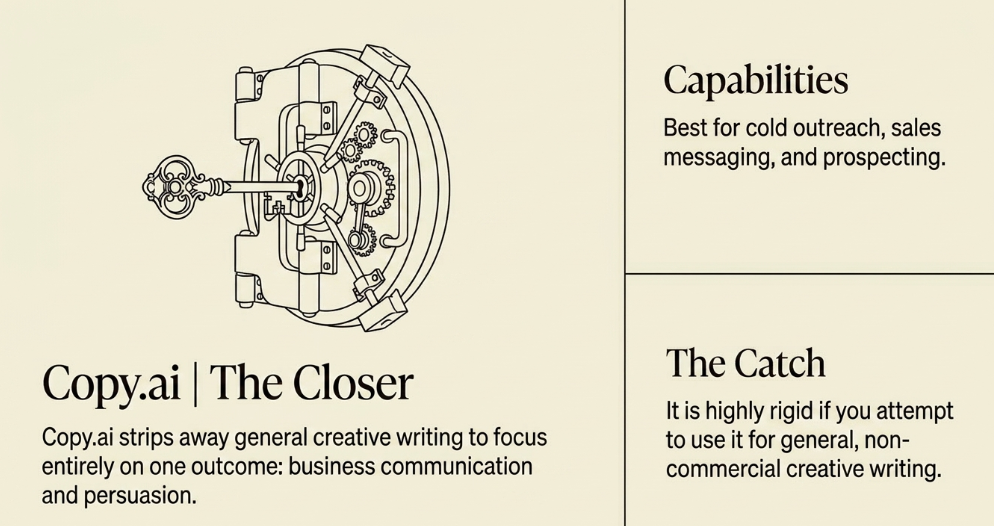
Best for Sales & Outreach
Copy.ai focuses heavily on business communication.
Cold emails.
Sales messaging.
Marketing campaigns.
If your job involves persuading people to buy something, it’s worth a look.
Strengths
Sales.
Marketing.
Prospecting.
Weaknesses
Less flexible for general writing.
5. Grammarly
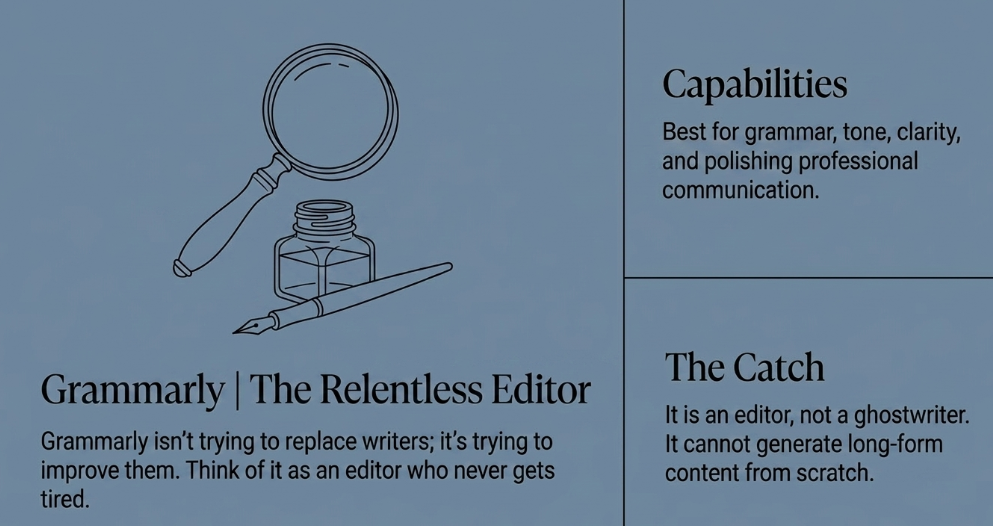
Best Editor
Grammarly isn’t trying to replace writers.
It’s trying to improve them.
That’s a much better business.
Instead of generating entire articles, it helps polish what you’ve already written.
Think of it as an editor who never gets tired.
Strengths
Grammar.
Tone.
Clarity.
Professional communication.
Weaknesses
It isn’t designed for creating long-form content from scratch.
6. Notion AI
Best for Internal Writing
If your company already lives inside Notion, this one feels natural.
Meeting notes.
Project documentation.
Internal wikis.
Brainstorms.
Everything stays in one place.
Strengths
Organization.
Documentation.
Knowledge management.
Weaknesses
Less powerful than dedicated AI writing platforms.
7. Sudowrite
Best for Fiction
This isn’t for writing blog posts.
It’s for writing stories.
Novelists love it because it helps with dialogue, descriptions, plot ideas, and character development.
Different audience.
Different job.
Strengths
Creative writing.
Storytelling.
Brainstorming.
Weaknesses
Not designed for business writing.
Which Tool Writes the Best?
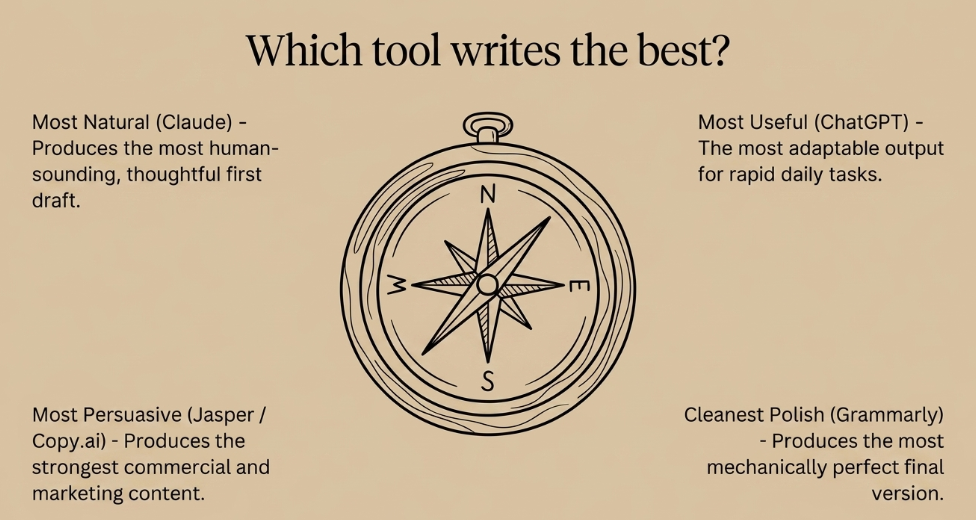
This is the question everyone asks.
Here’s my answer.
Claude usually produces the most natural first draft.
ChatGPT produces the most useful overall output.
Jasper produces the strongest marketing content.
Grammarly produces the cleanest final version.
Notice something?
They’re solving different problems.
That’s why comparing them is harder than it looks.
My Personal Workflow
Here’s how I’d build a simple writing system.
Step 1
Use ChatGPT to brainstorm ideas.
Step 2
Draft the article in Claude.
Step 3
Refine the structure and add original insights yourself.
This part matters.
AI can help you write.
It can’t replace your experience.
Step 4
Run the final draft through Grammarly.
Publish.
Simple.
The Biggest Mistake People Make
People expect AI to write perfect articles.
It won’t.
At least not consistently.
The best writers don’t copy and paste AI output.
They collaborate with it.
They ask better questions.
Challenge weak ideas.
Rewrite awkward sections.
Add personal experience.
That’s where quality comes from.
Think of AI like an incredibly fast intern.
It gives you a strong starting point.
You’re still responsible for the finish.
Should You Pay for an AI Writing Tool?
If you write once a month?
Probably not.
If writing is part of your job?
Absolutely.
One saved hour every week quickly pays for the subscription.
The return on investment isn’t measured in words.
It’s measured in time.
And time is usually the most expensive thing an entrepreneur owns.
Final Thoughts on Writing Tools
The debate over the “best AI writing tool” misses the bigger picture.
Writing has always been a competitive advantage.
The internet rewarded people who published consistently.
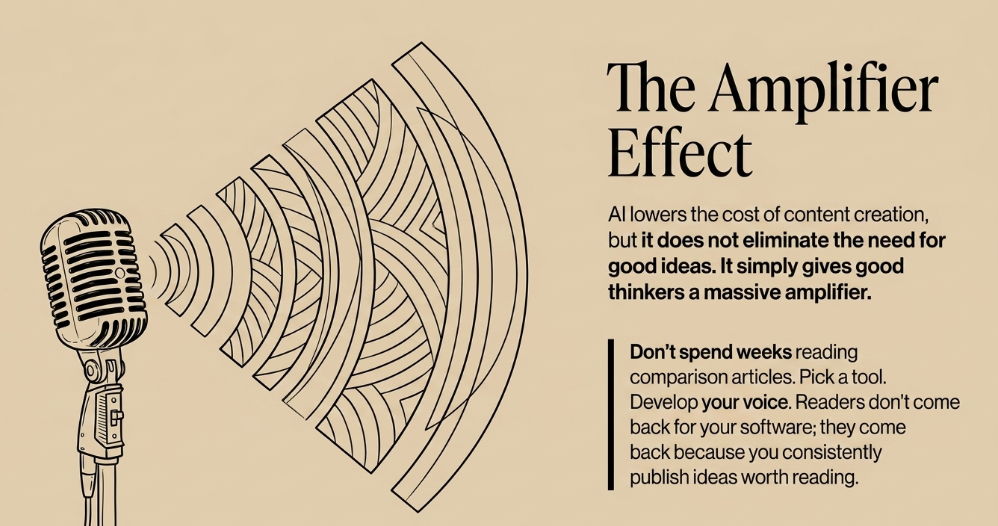
AI lowers the cost of creating that content.
It doesn’t eliminate the need for good ideas.
It simply gives good thinkers a much bigger amplifier.
So don’t spend weeks reading comparison articles.
Pick one tool.
Write every day.
Improve your prompts.
Develop your voice.
Because in the end, readers don’t come back because you used the best software.
They come back because you consistently publish ideas worth reading.



[…] AI website builders are getting better. […]