

A few years ago, I hired someone to help with research.
Today, I ask AI.
That’s not because people aren’t valuable.
It’s because the economics have changed.
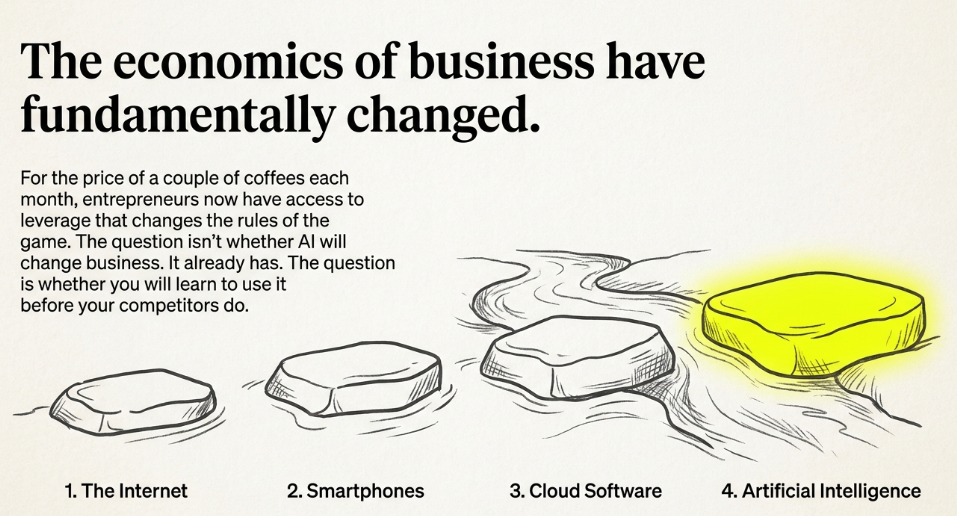
For the price of a couple of coffees each month, entrepreneurs now have access to tools that can write, analyze, brainstorm, summarize, translate, code, and even help make business decisions.
We’re living through one of those rare moments where technology changes the rules of the game.
The internet did it.
Smartphones did it.
Cloud software did it.
AI is doing it now.
The question isn’t whether AI will change business.
It already has.
The question is whether you’ll learn to use it before your competitors do.
If you’re just getting started, this guide is for you.
First, Forget the Buzzwords
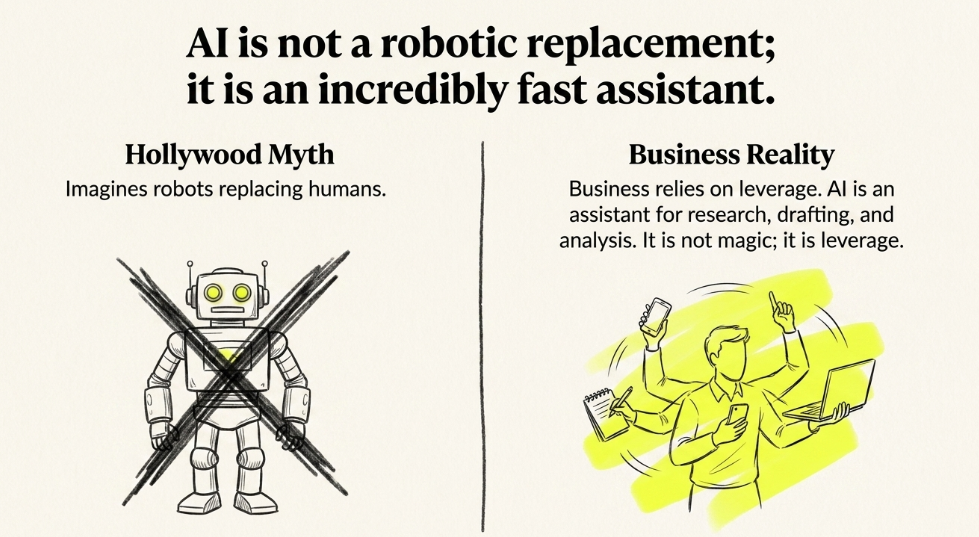
When people hear “artificial intelligence,” they imagine robots replacing humans.
That’s mostly Hollywood.
A better way to think about AI is this:
It’s an incredibly fast assistant.
Need ideas?
Ask AI.
Need research?
Ask AI.
Need a first draft?
Ask AI.
Need help understanding a complicated spreadsheet?
Ask AI.
It’s not magic.
It’s leverage.
And leverage has always been one of the biggest advantages in business.
AI Doesn’t Replace Entrepreneurs
This is the biggest misconception.
AI doesn’t build businesses.
People do.
What AI replaces are repetitive tasks.
Think about how much time you spend each week doing things like:
- Writing emails
- Researching competitors
- Summarizing meetings
- Creating social media posts
- Editing documents
- Brainstorming ideas
- Organizing notes
Now imagine cutting those tasks in half.
That’s where AI creates value.
It gives you more time to work on the parts of the business that actually require human judgment.
The Three AI Tools I’d Start With
There are hundreds of AI products.
Ignore most of them.
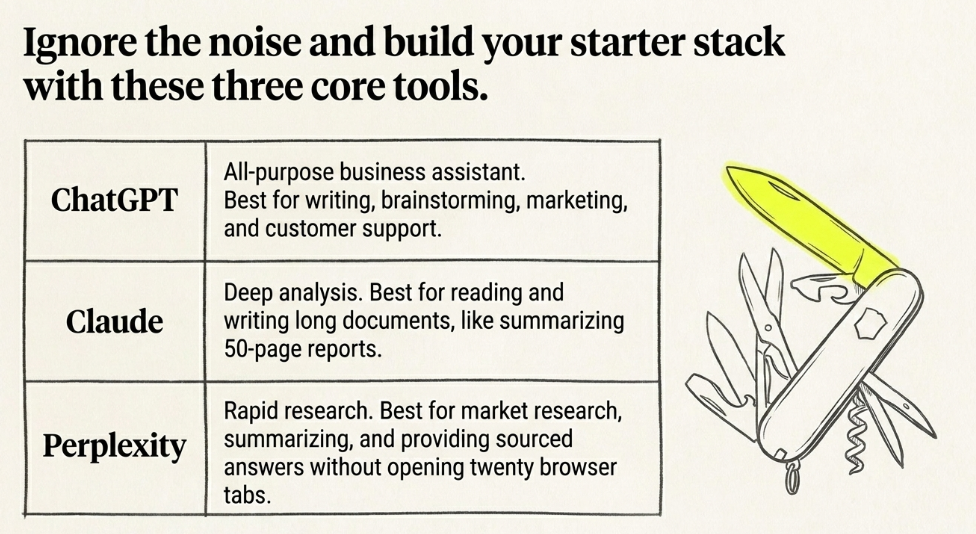
If you’re a beginner, start with three.
1. ChatGPT
Think of ChatGPT as your all-purpose business assistant.
Use it for:
- Writing
- Brainstorming
- Marketing
- Customer support
- Learning new skills
- Planning projects
If you only use one AI tool this year, make it ChatGPT.
2. Claude
Claude is excellent for reading and writing long documents.
Need to summarize a 50-page report?
Claude shines.
Writing an in-depth article?
Claude is often a great choice.
3. Perplexity
Research used to mean opening twenty browser tabs.
Perplexity makes that process dramatically faster.
It searches, summarizes, and provides sources in one place.
For entrepreneurs doing market research, it’s incredibly useful.
Five Ways Every Entrepreneur Can Use AI Today
Let’s make this practical.
Here are five things you could do before lunch.
Write Better Emails
Instead of staring at a blank screen, tell AI:
“Write a friendly follow-up email for a customer who requested a quote.”
You’ll have a solid draft in seconds.
Brainstorm Business Ideas
Ask questions like:
“What are ten business ideas serving local restaurants?”
Or:
“What problems do accountants complain about?”
AI is surprisingly good at helping you think wider.
Research Competitors
Paste your competitor’s website into an AI tool.
Ask:
“What are this company’s strengths?”
“What customer are they targeting?”
“What opportunities are they missing?”
You’ll often spot ideas you wouldn’t have noticed otherwise.
Create Marketing Content
Need:
- Blog posts
- Social media captions
- Ad headlines
- Product descriptions
AI dramatically speeds up the first draft.
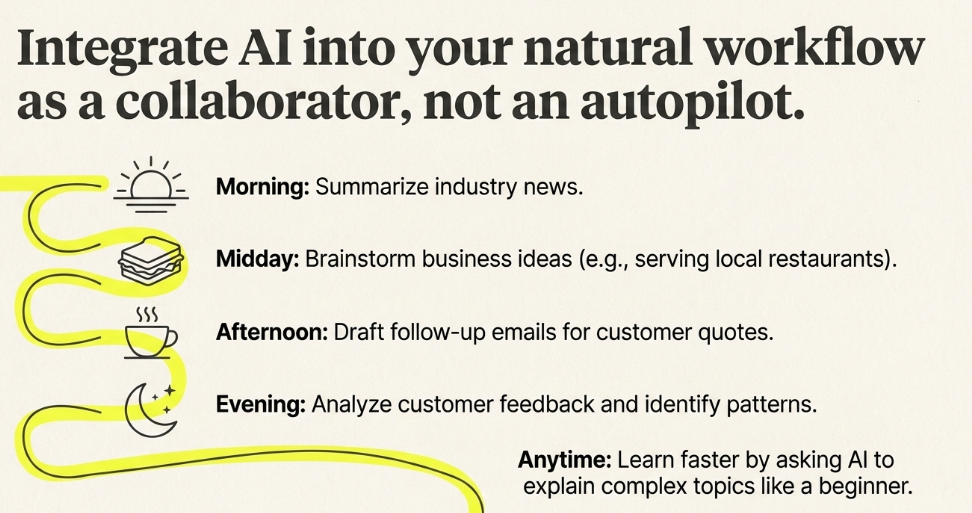
The key is remembering it’s a collaborator, not an autopilot.
Learn Faster
This is probably my favorite use.
Whenever I encounter a topic I don’t understand, I ask AI to explain it like I’m a beginner.
It’s like having a patient tutor available 24 hours a day.
The Biggest Mistake Beginners Make
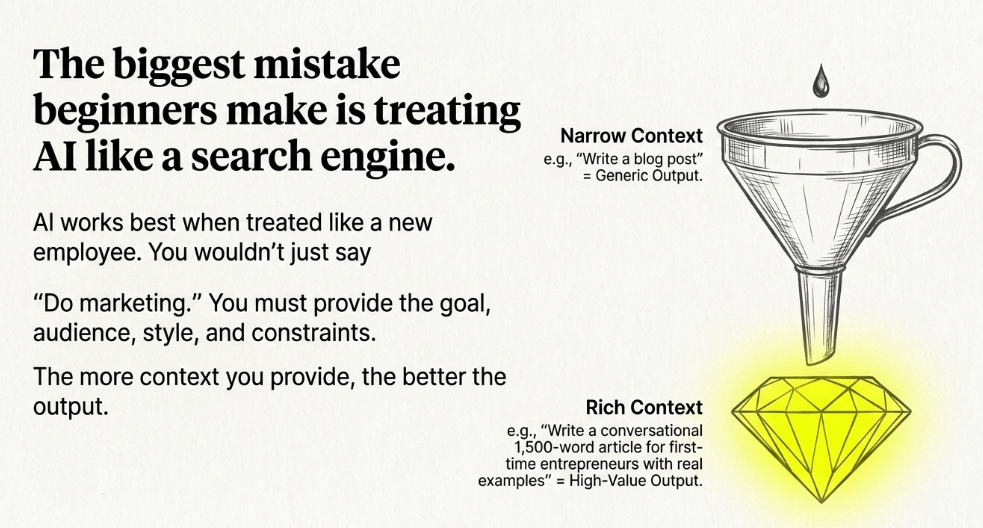
Most people treat AI like Google.
They type:
“Marketing.”
Or:
“Business ideas.”
That’s the wrong approach.
AI works best when you provide context.
Instead of asking:
“Write a blog post.”
Try asking:
“I’m writing for first-time entrepreneurs who want practical advice. Write a conversational 1,500-word article with real examples.”
The more context you provide, the better the output.
Think of AI like hiring a new employee.
You wouldn’t simply say:
“Do marketing.”
You’d explain the goal.
The audience.
The style.
The constraints.
AI is no different.
What AI Can’t Do
This is just as important.
AI can’t replace:
Judgment.
Taste.
Experience.
Relationships.
Trust.
Customers still buy from people.
Investors still back founders.
Teams still follow leaders.
AI can accelerate your work.
It can’t replace your thinking.
That’s good news.
The competitive advantage is still human.
My Simple AI Workflow
If I were starting an online business today, my day might look something like this:
Morning:
Ask AI to summarize industry news.
Midday:
Use AI to brainstorm content ideas.
Afternoon:
Draft articles and emails with AI.
Evening:
Analyze customer feedback and identify patterns.
Notice something?
AI is helping with almost everything.
But it’s not making the decisions.
I am.
That’s exactly how it should work.
Where Entrepreneurs Should Be Careful
AI is powerful.
It’s also imperfect.
Sometimes it makes mistakes.
Sometimes it sounds more confident than it should.
Always verify:
- Financial information
- Legal advice
- Medical information
- Important statistics
- Customer-facing claims
Treat AI like an enthusiastic intern.
Helpful?
Absolutely.
Infallible?
Not even close.
Final Thoughts
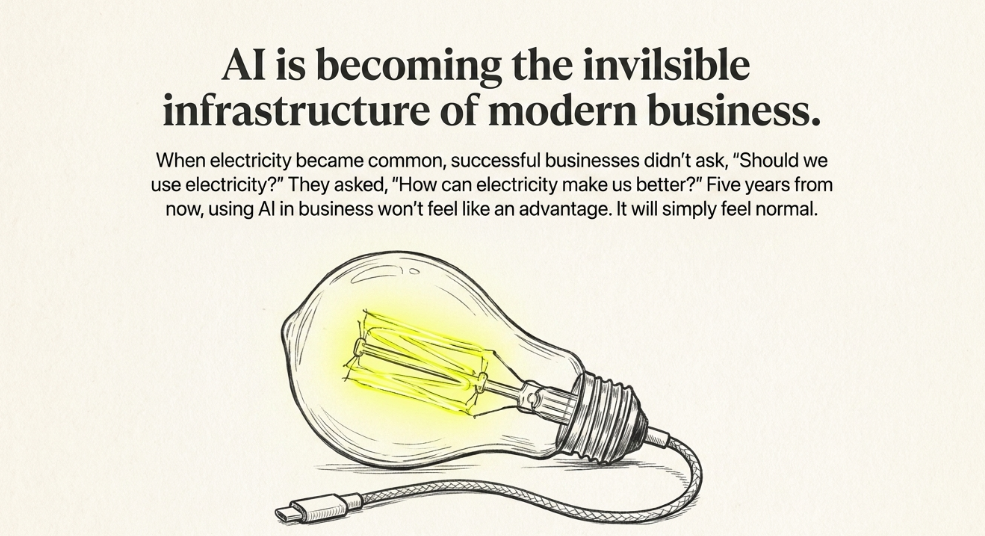
When electricity became common, successful businesses didn’t ask:
“Should we use electricity?”
They asked:
“How can electricity make us better?”
AI is similar.
It’s becoming part of the infrastructure of modern business.
The entrepreneurs who thrive over the next decade won’t necessarily be the ones with the biggest budgets or the smartest ideas.
They’ll be the ones who learn to use new tools faster than everyone else.
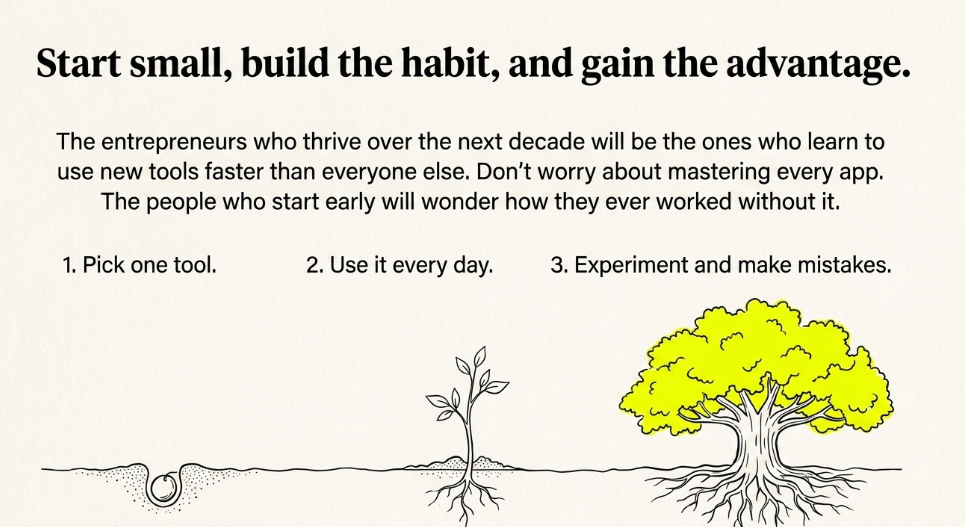
So don’t worry about mastering every AI app.
Pick one.
Use it every day.
Experiment.
Make mistakes.
Build the habit.
Because five years from now, using AI in business probably won’t feel like an advantage.
It’ll simply feel normal.
And the people who started early will wonder how they ever worked without it.


[…] After testing the biggest players, here’s where I’d spend my time. […]